
How Long Should a Composite Door Last?
By the Skyway team · 5 October 2026
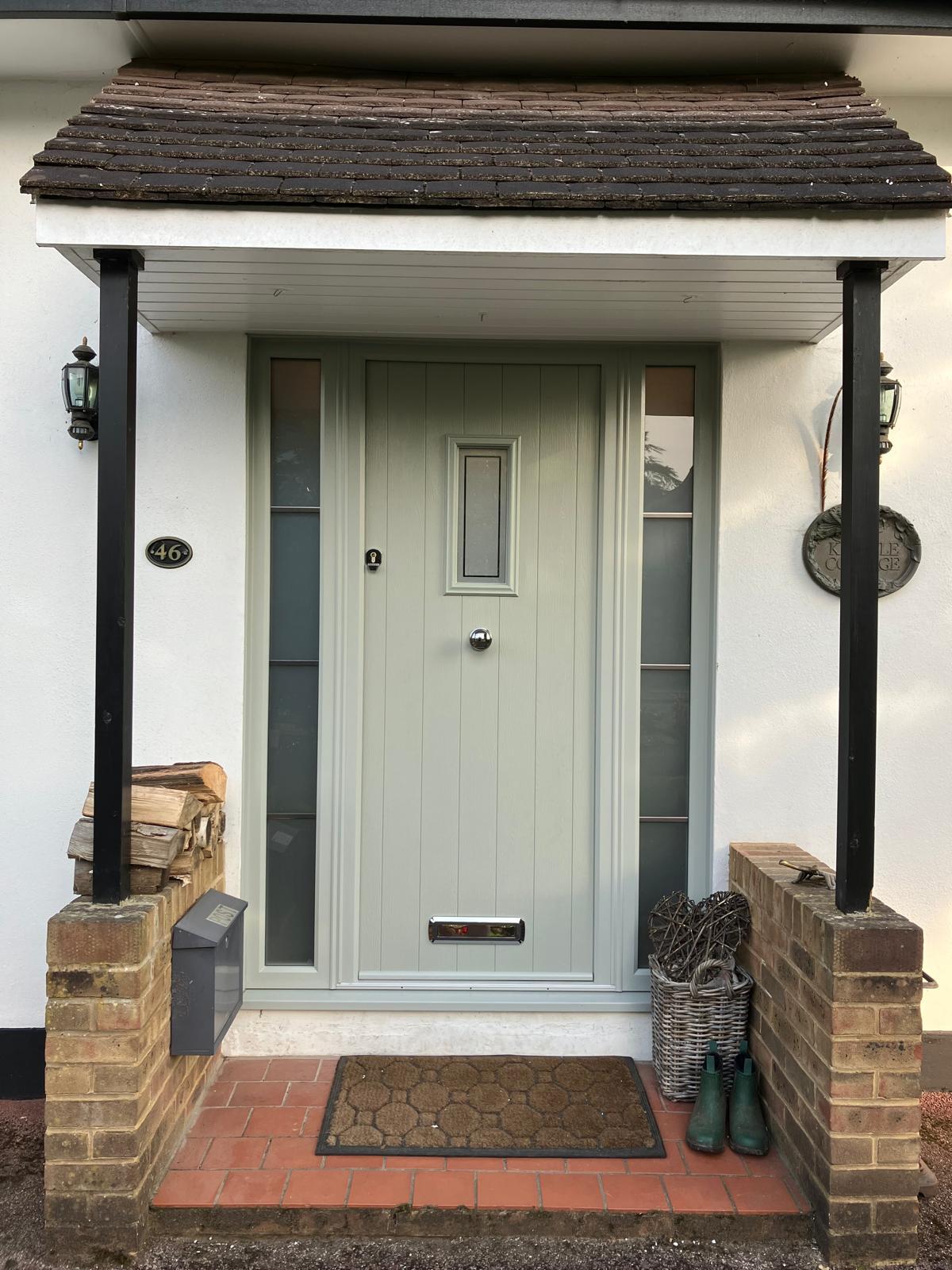
Longer than the hardware bolted to it, which is why the honest answer to this question is not a number of years. A composite door slab is a solid core wrapped in a glass reinforced plastic skin, and that assembly is not what fails. The hinges, the cylinder, the multipoint gearbox and the seals are the parts that wear out, and they will reach the end of their working life while the door itself still looks and performs perfectly well.
That reframing matters when you are comparing quotes, because two doors offered at very different prices often have near identical slabs and completely different hardware behind them. From working with clients across Epsom, Cobham and Tadworth, we've found the most useful question to put to any installer is not how long the door lasts, but what the cylinder and hinges are and how the guarantee splits between the slab and the moving parts. That one question separates quotes far more reliably than the headline figure does.
What actually wears out first?
The moving parts, and in a fairly predictable order.
- The cylinder is usually first. It is a mechanical component handling daily use, and it is also the part most worth upgrading anyway on security grounds, so replacing it is rarely a grievance.
- The multipoint gearbox is the expensive one. It is the mechanism the handle drives, and the most common cause of premature failure is not age at all, it is somebody forcing the handle against a door that is stiff or misaligned.
- Hinges loosen and the door drops. This is adjustment rather than failure for most of the door's life, and it only becomes a replacement job if it is left long enough to wear the keeps.
- Seals go hard and stop compressing. They are cheap and replaceable, and a door that has become draughty often needs nothing more than this.
- The threshold and its drainage collect grit and block, which puts water where it should not be sitting.
None of that is the slab. A properly made composite door will still be structurally sound when it is on its second cylinder and its second set of seals, which is exactly why measuring its life in years misses the point.
Does the core make a difference to how long it lasts?
Yes, and it is the main structural difference between the ranges.
- Endurance builds on a 48mm solid timber core, laid up from seventeen layers of laminated veneer.
- Solidor uses a 48mm solid timber core too, with three layers of laminated veneer.
- Apeer takes a different route entirely, leading on thermal performance rather than a solid timber core.
- Solidcore is the fourth range we fit, and like the others it gets specified against the opening rather than by default.
The practical consequence of a solid core is not that the door survives longer in the abstract. It is that the hinge screws and the lock keeps are fixing into solid material. In our experience, a solid timber core door works better than a foam filled one over a fifteen year horizon because the fixings stay tight, and a door whose fixings stay tight does not drop, and a door that does not drop never puts the strain on its gearbox that breaks gearboxes. The core protects the hardware, which is the part that actually decides the door's working life.
What does the guarantee really cover?
This is where the difference between quotes is usually hiding, and it is worth reading rather than assuming.
A composite door guarantee typically covers the slab, meaning the core and the GRP skin, against things like warping and delamination. The moving parts are very often guaranteed separately and for a much shorter period. A door advertised with a long guarantee may have hardware covered for a fraction of that time.
Ask for the cover to be stated as two separate periods rather than one headline number, and ask specifically about the cylinder, the gearbox, the hinges and the seals. An installer who can answer that without checking is telling you something useful about how often they deal with it.
The other half of the question is who honours it. A manufacturer guarantee on the slab is only reachable through somebody willing to come and look at the door, so the installer's own position matters. Ours carry an insurance backed guarantee, which is the mechanism that protects the cover if a company is no longer trading. It is worth understanding on any quote, not just ours.
Do composite doors fade?
They can, and the honest version of this answer depends on the colour and the elevation.
The GRP skin holds colour far better than a painted timber door, which is one of the main reasons people move to composite in the first place. It is not immune to ultraviolet light though, and the doors most likely to show it are dark colours on elevations that get sustained direct sun. A black or anthracite door on a south facing front elevation is working considerably harder than the same door facing north.
This is a specification conversation rather than a reason to avoid a colour. If you want a dark door on a hot elevation, it is a fair question to ask what the skin is and what the guarantee says about colourfastness, and to make that part of the comparison.
What shortens a composite door's life the most?
Four things, and three of them are avoidable.
- Forcing a stiff handle. By some distance the most common cause of a premature gearbox failure we get called to. If a door is not locking easily, something needs adjusting rather than more force.
- Leaving a dropped door alone. A door that has sagged is dragging its hooks across the keeps every single time it is locked. Adjusting a hinge is a small job. Replacing worn keeps and a chewed gearbox is not.
- Blocked threshold drainage. Grit and leaves fill the drainage channel, water sits against the bottom of the door and frame, and it goes on doing so unseen.
- Poor installation. A door fitted out of square never sits right, and no amount of later adjustment fully recovers it. This one is not the homeowner's to fix, which is why the fitting matters as much as the product.
What maintenance actually makes a difference?
Very little, but it is not nothing, and it is almost entirely about the hardware.
- Lubricate the moving parts once or twice a year. The hinges, the multipoint mechanism and the cylinder. This is the single highest value thing you can do and it takes minutes.
- Keep the threshold drainage clear. A brush along the channel, checked when you clean the door.
- Wash the slab with soapy water rather than anything abrasive. Solvent cleaners and scouring pads damage the skin, and the damage is permanent.
- Get a dropped door adjusted early. Ideally the moment you notice the handle needs lifting harder than it used to.
Should you replace a composite door or repair it?
Repair, in most cases, and considerably more often than people expect.
If the slab is straight, the skin is undamaged and the frame is square, then a failed cylinder, a worn gearbox, tired seals or dropped hinges are all repairs rather than reasons to buy a new door. That is true even when the door is well into its second decade.
Replacement genuinely makes sense where the slab itself has gone, meaning it has warped, delaminated or been damaged, or where the frame has moved, or where the door was never right from the day it went in. It is also reasonable if the security specification is simply out of date and you would rather start again than upgrade piecemeal.
If you are weighing the front elevation as a whole, it is worth settling whether the door or the windows come first, since doing both in one visit is usually less disruptive and better value than two separate jobs. And if the concern is security rather than age, the locking hardware specification is where that conversation actually belongs, on the door as much as on the windows.
So, how long should a composite door last?
Long enough that the question is the wrong one. Assume the slab will outlive the hardware, and judge a quote on the hardware and the guarantee split rather than on a headline number of years.
Practically, that means asking three things before you order. What cylinder is included, what the hinges and gearbox are, and how many years cover the slab against how many years cover the moving parts. A door with an excellent slab and budget hardware will disappoint you long before a door specified sensibly throughout.
We fit composite entrance doors from four ranges and our team has over 30 years of combined experience across Surrey, so we are happy to say when a door needs adjusting rather than replacing. If yours is stiff, dropped or simply due a look, get in touch.
Ready to start your project?
Get a free, no-obligation quote from a FENSA-registered installer with over 30 years of experience across Surrey.