
Composite Doors Tadworth
By the Skyway team · 14 September 2026
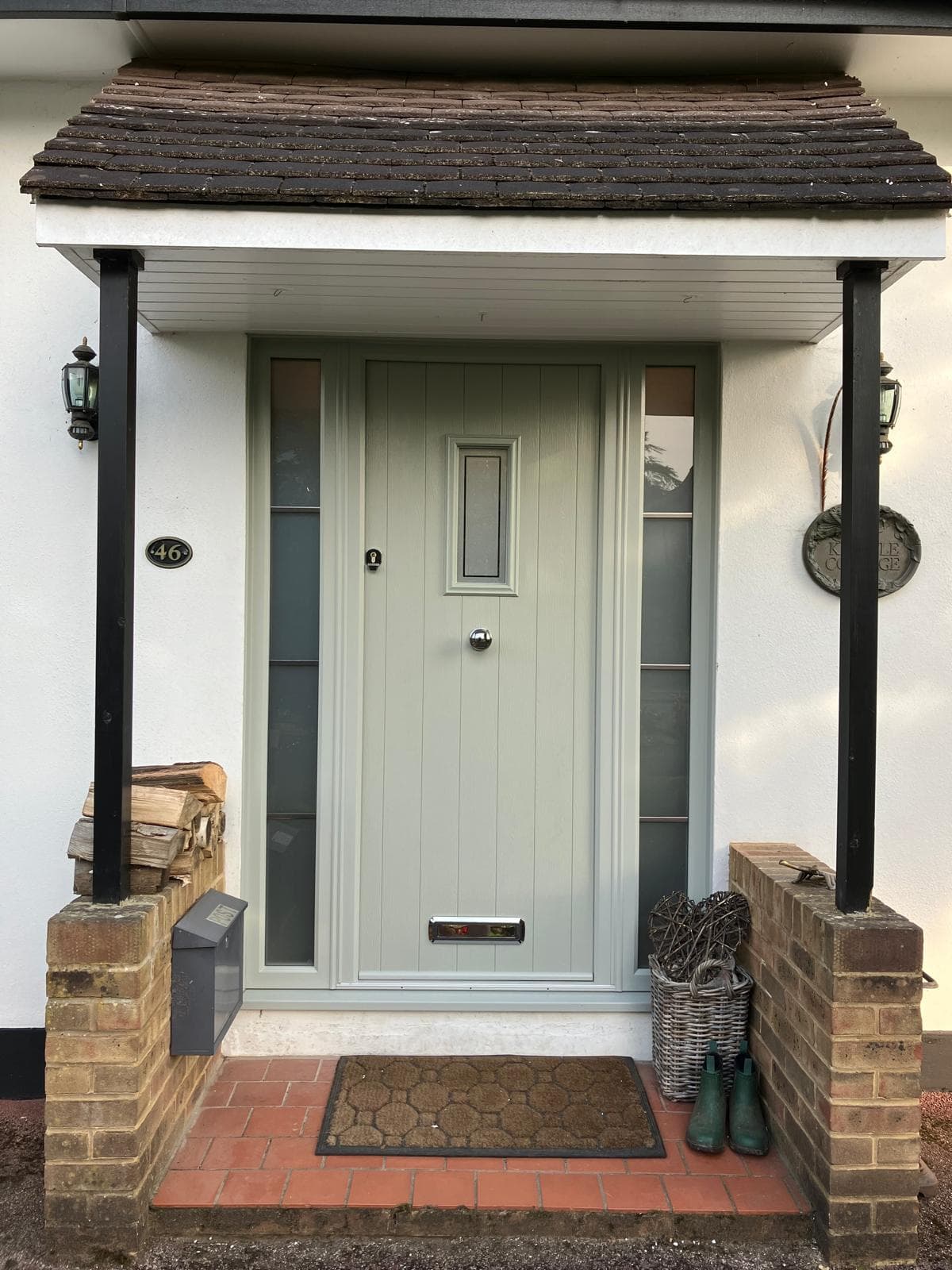
If you are looking at composite doors in Tadworth, the short answer is that they suit most of the housing here very well. A composite front door is thicker, better insulated and considerably harder to force than the timber or early uPVC doors found on much of the village's interwar stock, and the range of finishes now available means a modern door need not look out of place on a 1930s elevation.
The caveat worth knowing before you order is that Tadworth is not one kind of place, and the right door genuinely varies from street to street. The three questions that actually decide the job are what your elevation faces, whether your property sits inside a conservation area, and how wide the opening really is. Settle those and most of what is left is colour.
What kind of housing are we dealing with in Tadworth?
Mostly early twentieth century, and that matters more than it first sounds.
Tadworth was a hamlet until the railway arrived in 1901, which brought it within commuting reach of London and set off a building boom. From the early 1900s through to the 1930s, large brick Arts and Crafts houses went up for buyers who wanted a substantial home in the country. Smaller middle-class housing followed by the 1930s, with the lands of Profitts Farm and Corner Farm built over and the Tadworth Court Estate developed in the same decade.
Neighbouring Walton-on-the-Hill has a character of its own again, with larger detached houses from the early to mid twentieth century including work by Sir Edwin Lutyens and architects who followed him, while Kingswood still holds original 1920s Costain homes.
The practical consequence is that a great many Tadworth front doors sit in deep porches, beneath substantial brick or tile-hung elevations, in openings wider than a standard doorset. That is an excellent setting for a composite door. The same building period also explains much of the window stock across Tadworth, which is why doors and windows here so often come up for replacement together.
What is actually inside a composite door?
Not all of them are built the same way, and the core is where the real differences sit.
A composite door is a solid core wrapped in a glass reinforced plastic skin. The skin gives the colour, the woodgrain texture and the weather resistance, and it is the reason the door never needs painting. The core gives it strength, insulation, and the material that the locks and hinges actually fix into.
- Solidor builds on a 48mm solid timber core, using three layers of laminated veneer.
- Endurance uses a 48mm solid timber core as well, built up from seventeen layers of laminated veneer.
- Apeer takes a different route, leading on thermal performance rather than on a solid timber core.
- Solidcore is the fourth range we fit, and like the others it gets specified for the job rather than because it happens to be on the van.
Fitting all four is deliberate. A solid timber core door suits a Tadworth front elevation better than a foam filled one, because the lock keeps and the hinge screws are biting into solid timber rather than into foam, and on the wide heavy leaves these houses often need, that is what stops a door dropping on its hinges after a couple of winters. It is the same reason core thickness matters for security, since a deeper door gives the lock bolts more material to engage with.
Do you need planning permission for a new front door in Tadworth?
Usually not, but Tadworth is one of the places where that answer needs checking rather than assuming.
Replacing a door with one of similar appearance to those used in the construction of the house is normally permitted development, and the Planning Portal is clear on that point. Three situations change it.
- Conservation areas carrying an Article 4 Direction. Reigate and Banstead Borough Council state that Article 4 Directions have been served on most conservation areas in the borough, controlling external changes to dwelling houses. Walton-on-the-Hill, immediately next to Tadworth, has a conservation area, so it is worth checking the council's own map against your address before ordering rather than afterwards.
- Listed buildings need listed building consent for significant works, which is a separate permission from planning and is not satisfied by having one without the other.
- Flats and maisonettes do not carry the permitted development rights a house does, so the lease and the freeholder both come into it.
There is one local point worth clearing up, because it reliably causes confusion. Reigate and Banstead brought in an Article 4 direction covering the borough's town and local centres, Tadworth and Walton-on-the-Hill among them, which came into force on 13 February 2026. That one removes permitted development rights to convert ground floor commercial units into homes. It has nothing whatever to do with front doors on houses, and it is the first thing that comes up if you search for Article 4 in Tadworth.
What about building regulations?
A replacement door is notifiable, in exactly the same way a replacement window is, and this is the part homeowners are least often aware of.
Approved Document L sets a limiting U-value of 1.4 W/m²K for a replacement door in an existing dwelling, and the guidance adds that a replacement should not perform worse than the door being taken out. A FENSA registered installer self-certifies that the work complies and registers it, which is what produces the certificate a buyer's solicitor asks for when you come to sell. Skyway are FENSA registered under number 41110.
If you are weighing up the whole front elevation at once, it is worth deciding whether the door or the windows come first, because doing both in a single visit is usually far less disruptive than booking two separate jobs months apart.
How secure is a composite door, really?
Considerably more secure than whatever it is replacing, provided the cylinder is right.
The door slab itself is rarely the weak point. The overwhelming majority of forced entries through uPVC and composite doors go through the cylinder, using a technique called lock snapping. A TS007 3 star cylinder is designed specifically to resist it, and it is an inexpensive component of an expensive door.
- Ask which cylinder is included rather than assuming one is, because this is precisely where corners get cut to sharpen a quote.
- PAS 24 is the enhanced security standard referenced in Approved Document Q for new dwellings, and it is an entirely reasonable thing to ask about on a replacement too.
- A multipoint lock is only as good as its fixings, which brings you straight back to what the core is made of.
- Ask for laminated glazing in a door that is out of sight of the road, since that is a different specification from toughened glass and does a different job.
Which colours and styles suit the houses here?
Heritage colours tend to settle best, and the reason is the brickwork.
The Arts and Crafts and interwar houses across Tadworth are mostly warm red or multi-stock brick, frequently with tile hanging or render above. Against that, the deeper heritage greens, blues and off-whites usually look more at home than a stark black, though black and anthracite work well on the newer housing and on rendered elevations.
- A wide opening often suits a door with sidelights rather than one oversized leaf, which keeps the proportions honest and the leaf a sensible weight to hang.
- Deep porches change how a colour reads, because the door sits in shade for most of the day and a very dark colour can disappear into it entirely.
- South and west facing doors work harder than others, and dark colours on those elevations absorb more heat, which is better discussed at the quoting stage than discovered later.
- Door furniture in a suitable finish does more for a period elevation than the door style does, and it is usually the cheapest element to get right.
How long will it last, and what does it need?
A long time, and very little, which is the main reason people move across from timber.
The glass reinforced plastic skin does not need painting, does not rot, and does not want the annual attention a timber door does. What it does need is occasional care of the moving parts, meaning the hinges, the multipoint mechanism and the cylinder, along with keeping the threshold drainage clear so water is not sitting against the bottom of the frame.
It is worth being straight about one thing here. If you are replacing a timber door because it has swollen and stopped closing cleanly, that swelling is often seasonal, and a well-made timber door can frequently be eased and re-finished for a fraction of the cost. If the bottom rail has gone soft or the joints have opened up, it is past that point and a composite replacement is the sensible move.
So, are composite doors right for a Tadworth home?
For most of the housing here, yes. The stock is largely early twentieth century with substantial elevations and generous openings, which suits a thick, well-insulated door, and the finishes available now mean a composite door can look properly at home on a 1930s house rather than obviously modern against it.
The things genuinely worth checking before you order are whether your property sits inside a conservation area carrying an Article 4 Direction, what the opening actually measures rather than what a standard size assumes, and which cylinder is included in the price. Those three settle most of the decision.
Our team has over 30 years of experience fitting composite entrance doors and composite doors across Surrey, we are FENSA registered under number 41110, and our installations carry an insurance backed guarantee. If you would like somebody to measure the opening properly and say which of the ranges suits your elevation, get in touch.
Ready to start your project?
Get a free, no-obligation quote from a FENSA-registered installer with over 30 years of experience across Surrey.