
Can You Get Blinds Inside Patio or Bifold Doors?
By Nick Munroe, Director · 19 October 2026
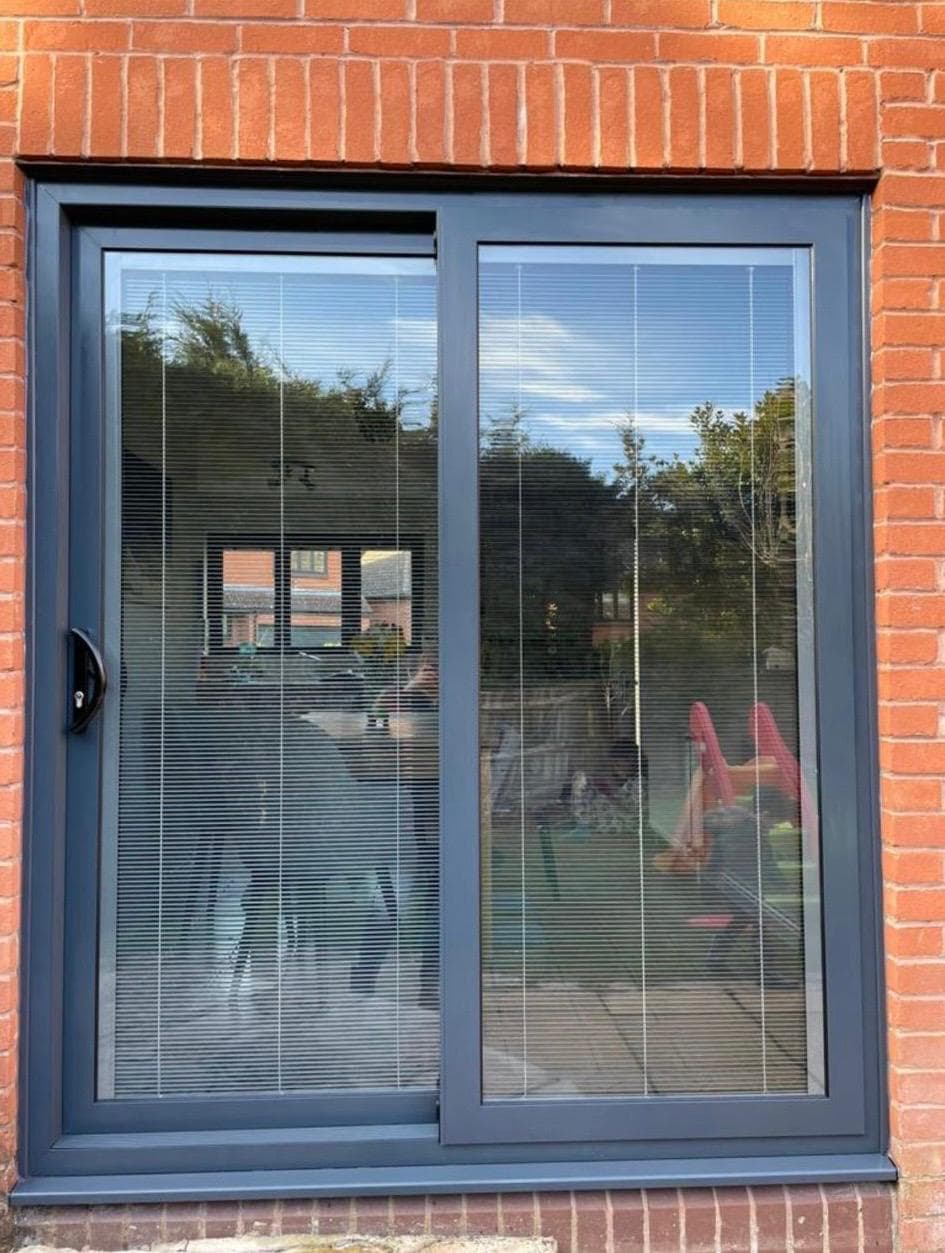
Yes. Integral blinds are built into the glass itself, sealed inside the double glazed unit between the two panes, and they can be specified in sliding patio doors and in bifold doors alike. You raise, lower and tilt them with a control on the face of the glass, usually a magnetic slider, or with a motor and a remote on some systems. Nothing hangs in front of the door, nothing gets in the way when it opens, and there are no cords.
We have fitted them in both kinds of door. One of the jobs on our aluminium patio sliding doors page is a Smart Visoglide slider in anthracite grey with integral blinds, and one customer's review describes new bifold doors where the integrated blinds were part of the job and finished on time with everything else. So this is a practical option rather than a specialist one, but it comes with trade offs that are worth understanding before you order.
How do integral blinds work?
The blind sits in the cavity of the sealed glass unit, and it can be a venetian, a pleated or a roller blind. Pilkington's ScreenLine system, one of the best known, can be worked by hand through a magnetic control that operates through the glass without breaking the seal, or motorised and run from a remote. Because the blind is sealed in, it never collects dust and the slats stay clean, which is the thing most people notice first once they live with them.
On the doors themselves, each glass panel carries its own blind. On a slider that means each pane, fixed or moving, has its own control. On a bifold every panel has one, so the blinds simply travel with the panels when the doors fold back.
Because the blind sits inside a sealed unit, the glass either side of it can still carry the coatings you would choose anyway. Pilkington's units can include low emissivity glass for insulation or a solar control coating, so choosing a blind does not mean giving up on the performance of the glass. The difference low-E glass makes is worth understanding before you settle the glass specification.
Why choose integral blinds over ordinary blinds or curtains?
Mostly because of the way these doors move.
A bifold folds back into a stack of panels at one or both ends of the opening. A curtain or a blind hung across the top of the opening has to clear that stack and the open panels, so it either gets in the way of the doors or has to be pulled right back every time they are used. On a slider, the moving pane runs past the fixed one in its own track, which limits what can be fixed to the face of either.
An integral blind suits a bifold better than a curtain does, because the folded panels and a drawn back curtain both want the same few feet of wall at the side of the opening, and in many kitchens and extensions that wall space simply is not there. With the blind inside the glass, the opening stays completely clear.
There are other reasons people choose them.
- No cords. Looped blind cords are a known danger to small children, and RoSPA advises choosing blinds without a looped cord, particularly in a child's bedroom. An integral blind has nothing hanging at all.
- No cleaning. The blind is sealed away from dust, cooking grease and condensation, which matters in a kitchen extension, where a great many of these doors end up.
- A clean look. With the blind raised, the door looks like a door, with nothing fixed to the frame or the wall around it.
What are the downsides?
They are real, and they deserve an honest look.
- A blind failure means a new glass unit. The blind lives inside a sealed unit, so there is no getting at it to repair it. If a mechanism fails outside its guarantee, the fix is a replacement sealed unit with a new blind inside. That is why the guarantee on the blind itself matters, and it is worth asking what it is. Pilkington, for example, quotes a five year guarantee on its ScreenLine models.
- You cannot take it down. If you tire of the colour, or a room changes use and you want something darker, the blind is fixed for the life of the unit.
- They cost more than the same door with plain glass, because the sealed units are a specialist product. Whether that is good value depends on what you would otherwise spend on blinds or curtains, and on how much you value the points above.
- Control is panel by panel. A wide bifold with five or six panels means five or six blinds to set, unless you choose motorised ones.
Where are integral blinds worth having?
It depends mostly on which way the glass faces and how the room is used.
- South and west facing doors are where they earn their keep, because glare and late sun across a kitchen table are usually the problem people are trying to solve.
- Rooms overlooked by neighbours, where privacy rather than sun is the issue, and where a venetian blind can be tilted to let the light in without letting the view in.
- Family kitchens and playrooms, for the cord and cleaning reasons above.
Where we would think twice is a north facing door with no privacy problem, where the blind may rarely come down at all, and a room whose use is likely to change, where a fixed colour and opacity could become a limitation.
Can you add integral blinds to doors you already have?
Sometimes, by replacing the sealed glass units rather than the whole door, but it depends on the door. The new units have to suit the depth of glass the frame was designed to take, so it is a question for a survey rather than something to assume. If your doors are due for replacement anyway, it is far simpler to specify the blinds with the new doors from the start.
Bifold or slider, which suits integral blinds better?
Both work well, so the choice between the doors should come from how you want the opening to behave, and the trade offs between bifold and sliding patio doors are worth settling first. Once that is decided, integral blinds are an option on either.
The one practical difference is the number of panels. A slider usually has fewer, larger panes, so there are fewer blinds to set and each one covers more glass. A bifold has more, narrower panels, and more blinds with them.
So, can you get blinds inside patio or bifold doors?
Yes, and they solve the very problems that make blinds awkward on these doors in the first place, with no fabric to clear from the opening, no cords and nothing to dust. The trade off is that the blind is part of the glass, so it cannot be repaired or changed without replacing the unit. Choose them where the sun or a neighbour's window gives you a reason to use them every day, and check the guarantee on the blind itself.
Skyway Windows fits bifold doors across Surrey and aluminium sliding patio doors from Smart and Origin, with or without integral blinds, and you can see finished jobs in our gallery. If you would like to know whether they would suit your opening, contact us.
Ready to start your project?
Get a free, no-obligation quote from a FENSA-registered installer with over 30 years of experience across Surrey.